
Sunday, November 8, 2026

Factory Shutdown Handover: Record What Is Not Ready to Restart

Two PPE-equipped workers review handover materials at a table; an enclosed stationary machine stands behind a rigid exclusion barrier in the factory.
AI-generated illustrative safety visual by GIGAMACH SDN BHD.

A factory shutdown handover should make unfinished work visible, not simply announce that a holiday or weekend has ended. After machinery relocation, maintenance or installation, a tidy-looking area can still contain unresolved checks. The next team needs to know which equipment remains on hold, why it is on hold and who can decide the next step.

Separate work completion from permission to restart

Consider a machine that has reached its final position, while a service connection still awaits inspection. “Positioning complete” describes one activity; it does not mean “ready for production.” Record these as separate decisions. A useful handover identifies the outstanding item and its responsible person instead of relying on a broad message such as “all done.”

Unexpected start-up and stored energy can seriously injure people during servicing. OSHA's hazardous-energy guidance explains why equipment-specific energy-control procedures and trained personnel matter. A handover note never authorises someone to remove another person's lock, bypass a safeguard or energise equipment that remains under isolation.

Five checks before handing over the work area

  • Name the equipment and current state. Use the site's equipment identifier and distinguish work completed, work outstanding and equipment still restricted from use. Avoid descriptions that could refer to several similar machines.
  • Record open tasks with an owner. For each unresolved connection, alignment check, guarding issue or inspection, identify the person or team responsible for assessment. Add a clear hold point: what must be confirmed before that activity can progress?
  • Maintain continuity of energy controls. Tell the incoming authorised team which work remains under the site's isolation arrangements. Any transfer or removal of controls must follow the applicable procedure; a change of shift or holiday does not itself release equipment.
  • Check the surrounding area. Identify temporary barriers, protected routes, tools, loose materials and access restrictions that remain relevant. Do not remove a barrier merely because the people who installed it have left.
  • Agree the next review. Record who will verify outstanding items, who must be informed and which site-authorised person can release the equipment. Keep the latest handover available to the people arriving next.

Common mistakes that hide unfinished work

An old photograph, a green tick beside a broad task or an unacknowledged group message can leave the next crew guessing. A record should describe the present condition, not just an earlier achievement. If an issue cannot be confirmed, keep it open rather than closing it to meet a planned restart time.

HSE's maintenance guidance highlights planning, clear communication, competent personnel and protection of others nearby. These references support general safety awareness; they are not statements of Malaysian legal requirements.

Final verification before release

The outgoing and incoming responsible people should compare the handover with the actual work area. Resolve conflicting information, confirm who owns every open item and acknowledge any continuing restrictions. Restart belongs to the facility's authorised process after its required checks, not to a delivery milestone or this checklist.

Coordinate the handling scope early

For planned industrial work in Malaysia, GIGAMACH SDN BHD supports machinery relocation and equipment positioning. Agree the boundary between handling, installation, inspection and facility release before work begins, so no unfinished responsibility disappears between teams.

Sunday, November 1, 2026

Lifting Gear Inspection: Keep Unverified Equipment Out of the Lift

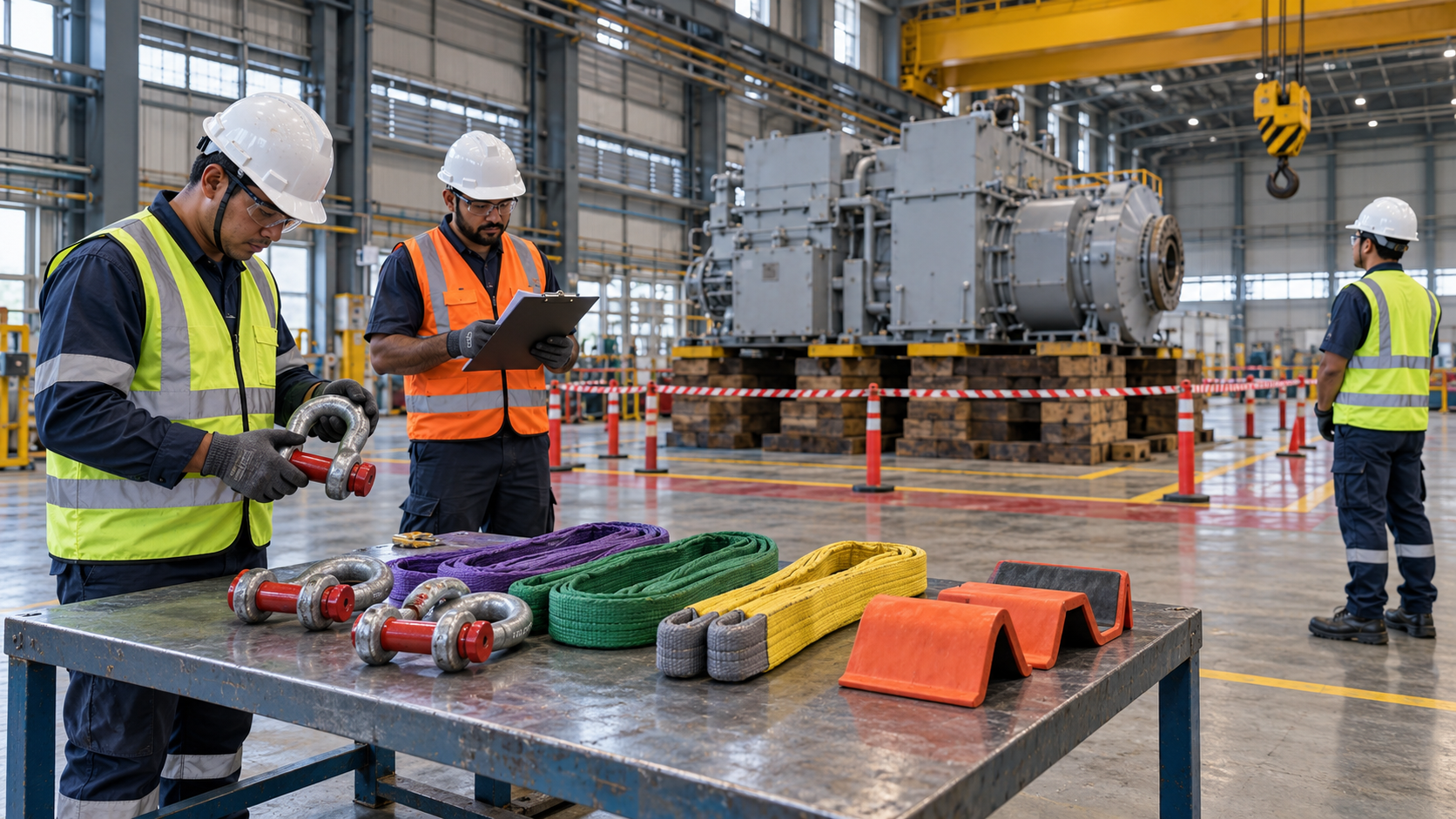
PPE-equipped workers examine unloaded shackles and textile slings at a factory inspection table; a stationary machine rests on supports behind an exclusion boundary.
AI-generated illustrative safety visual by GIGAMACH SDN BHD.

A useful lifting gear inspection needs a clear decision when an item cannot be verified. Finding an unreadable sling tag or a questionable shackle is only the first step. The next challenge is preventing that item from being picked up by another crew while its status is unresolved.

A missing tag is not a guessing exercise

Appearance alone cannot establish an accessory's identity, working load limit or suitability for the planned configuration. A sling that looks similar to another is not automatically interchangeable. Liftex lists missing or illegible identification among its sling removal criteria. Check the instructions for the actual product rather than estimating capacity from its colour or size.

Use a clear hold-and-handover process

  1. Stop selection. Keep the uncertain item out of the lifting arrangement. Do not perform a trial lift to decide whether unidentified equipment is suitable.
  2. Separate it. Use the site's controlled quarantine or hold area. A suspect sling left next to ready-to-use equipment can easily return to circulation.
  3. Record the concern. Note the available identification, the observed problem, who found it and where it was removed from use. Photograph the concern without attempting an improvised repair or replacement capacity label.
  4. Assign the decision. Notify the responsible supervisor or equipment custodian and refer technical questions to the competent person, supplier or manufacturer as appropriate. A rigger should not quietly substitute a different arrangement.
  5. Verify the replacement. Check the replacement item's identity, condition, rating and compatibility with the planned connections and loading direction. Rebrief the affected team if the arrangement changes.

For example, if an unreadable tag is discovered while preparing the next lift, leave the load securely supported and report the delay. The handover should identify the held item and its location, so a relief worker does not interpret an unattended sling as available equipment.

Quarantine is a control, not a clearance decision

SpanSet's inspection guidance stresses having a quarantine procedure to prevent withdrawn suspect equipment from returning to use. Moving an item to another shelf, cleaning it or attaching a temporary hold notice does not establish that it is fit for service.

Common mistakes include relying on a colleague's memory of capacity, taking a replacement from an unverified kit, and leaving the reason for withdrawal undocumented. Do not remove a hold merely because production is waiting.

Final verification before the lift

Confirm that the suspect item remains segregated, the replacement has been accepted through the appropriate process, and the lifting team understands any change. Release equipment from hold only through the responsible assessment and authorisation process. Follow the manufacturer's instructions and site-specific method; this article is practical awareness, not a statement of Malaysian legal requirements.

GIGAMACH SDN BHD supports rigging and industrial machinery handling in Malaysia. Plan equipment checks and contingency arrangements early so uncertainty can be resolved before the load is connected.

Factory Shutdown Handover: Record What Is Not Ready to Restart

AI-generated illustrative safety visual by GIGAMACH SDN BHD. A factory shutdown handover should make unfinished work visible, not simply an...