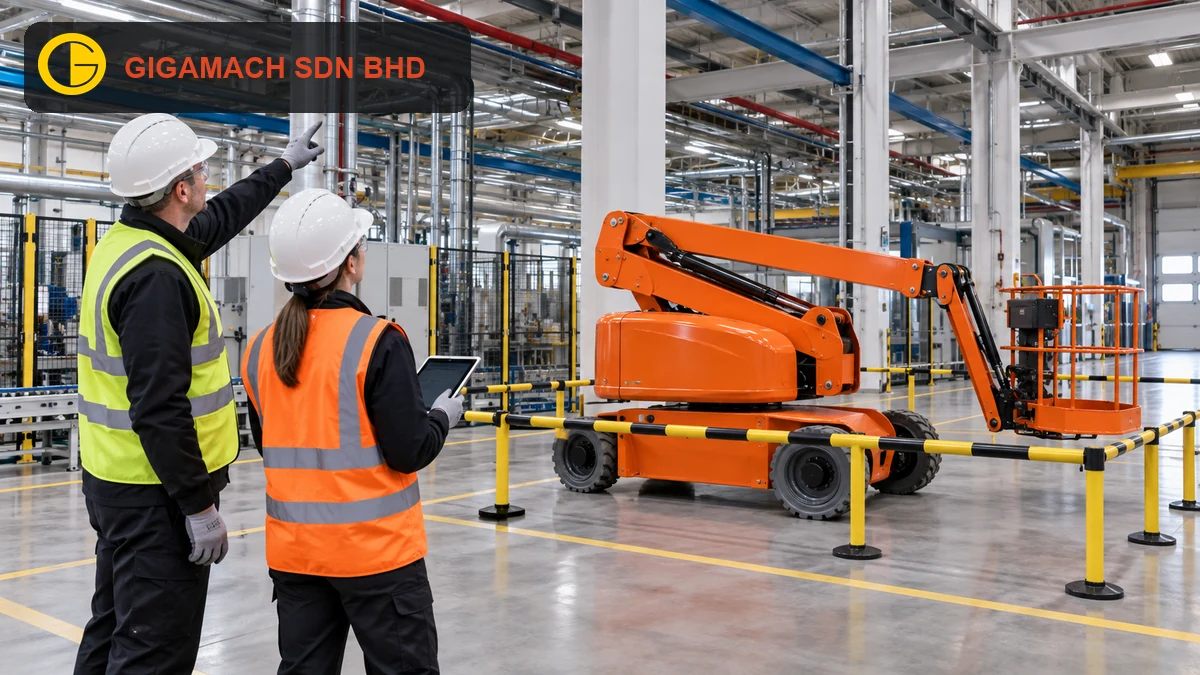
Planning for boom lift and scissor lift rental requires more than the correct machine or lifting equipment. When a boom lift works near beams, pipework, walls or equipment, a small platform movement can close the available clearance quickly. The operator must stay aware of the full work envelope—not only the task directly ahead.
For industrial teams working in Shah Alam, Selangor, early planning helps identify access, load, ground, personnel, and coordination risks before equipment is mobilised.
Why Boom lift positioning and operator protection from trapping hazards near structures matters
Access equipment must match the required working height, outreach, platform load, ground condition, and surrounding hazards. Selecting a machine by height alone can leave the operator without suitable reach or a stable operating setup.
The work method should be based on verified site and load information. A checklist supports the planning discussion, but it does not replace a task-specific assessment by competent personnel.
Practical pre-work checklist
- Check 1: Inspect overhead, side and travel-path hazards before elevation.
- Check 2: Choose a setup that avoids positioning the platform between fixed structures.
- Check 3: Use slow, deliberate movements and maintain sight of the movement.
- Check 4: Keep the body inside the guardrails and use fall protection as required by the manufacturer and site.
- Check 5: Control the area below and maintain communication with capable ground support.
- Check 6: Stop before clearance is lost; reposition instead of forcing the platform or overreaching.
Record the important findings during the site survey and brief the same controls to operators, riggers, signalmen, supervisors, and nearby work teams. Stop and reassess whenever the site condition or equipment configuration differs from the plan.
Common mistakes to avoid
- Selecting equipment before checking ground condition and access width.
- Ignoring platform capacity, overhead hazards, or nearby vehicle traffic.
- Starting work without completing the pre-use and function checks.
Related planning terms include aerial work platform selection, pre-use inspection, working at height. These should be used naturally to describe the actual work scope, not treated as interchangeable services.
Final verification before work starts
Before raising the platform, verify the work zone, emergency lowering arrangement, operator communication, weather limitations, and safe access to and from the platform.
Keep clearance. Keep control.
Planning support for industrial work
GIGAMACH SDN BHD provides boom lift and scissor lift rental with a practical safety-first approach. Plan the scope early so the equipment, access, lifting method, transport, and final positioning can be coordinated before work begins.