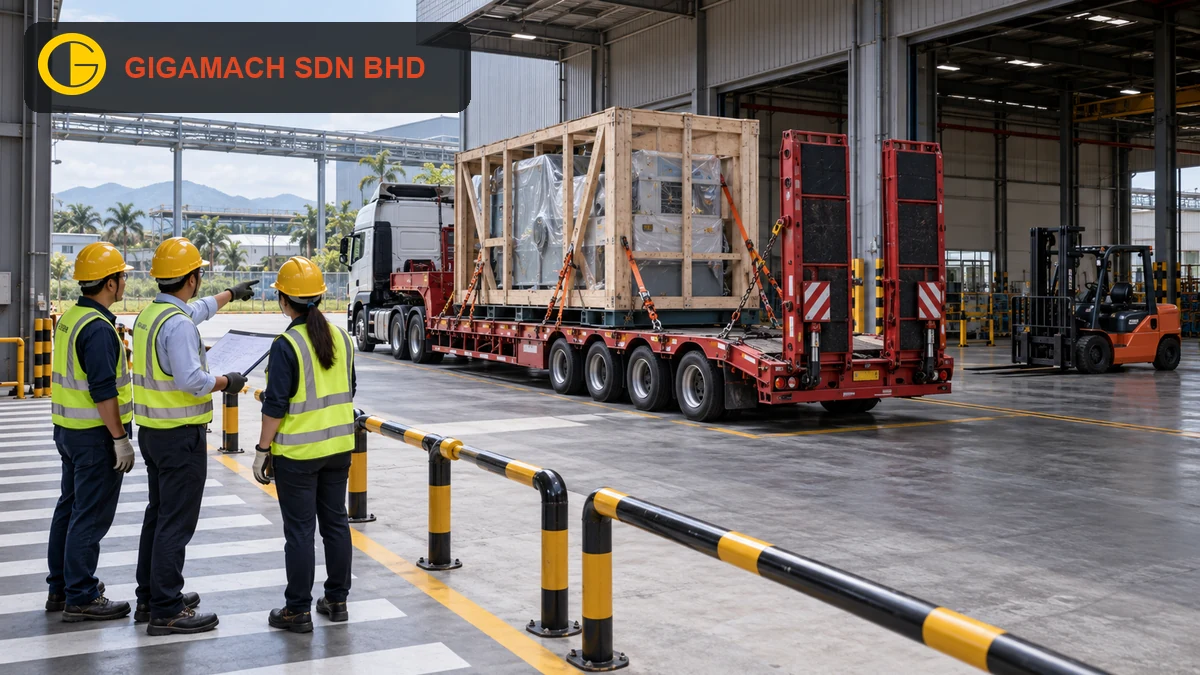
Planning for forklift operations requires more than the correct machine or lifting equipment. Safe forklift operations begin before the forks leave the floor. A crate can look balanced while its real weight distribution and support points tell a different story.
For industrial teams working in Malaysia, early planning helps identify access, load, ground, personnel, and coordination risks before equipment is mobilised.
Why Forklift fork placement and load-support verification before moving crated industrial machinery matters
Forklift capacity depends on the complete operating condition, not only the load weight. Load dimensions, centre of gravity, attachment, fork position, lift height, travel surface, and pedestrian control must be considered together before movement begins.
The work method should be based on verified site and load information. A checklist supports the planning discussion, but it does not replace a task-specific assessment by competent personnel.
Practical pre-work checklist
- Check 1: Confirm the packed weight, dimensions and centre of gravity from reliable information.
- Check 2: Check the forklift data plate and any attachment effect on capacity.
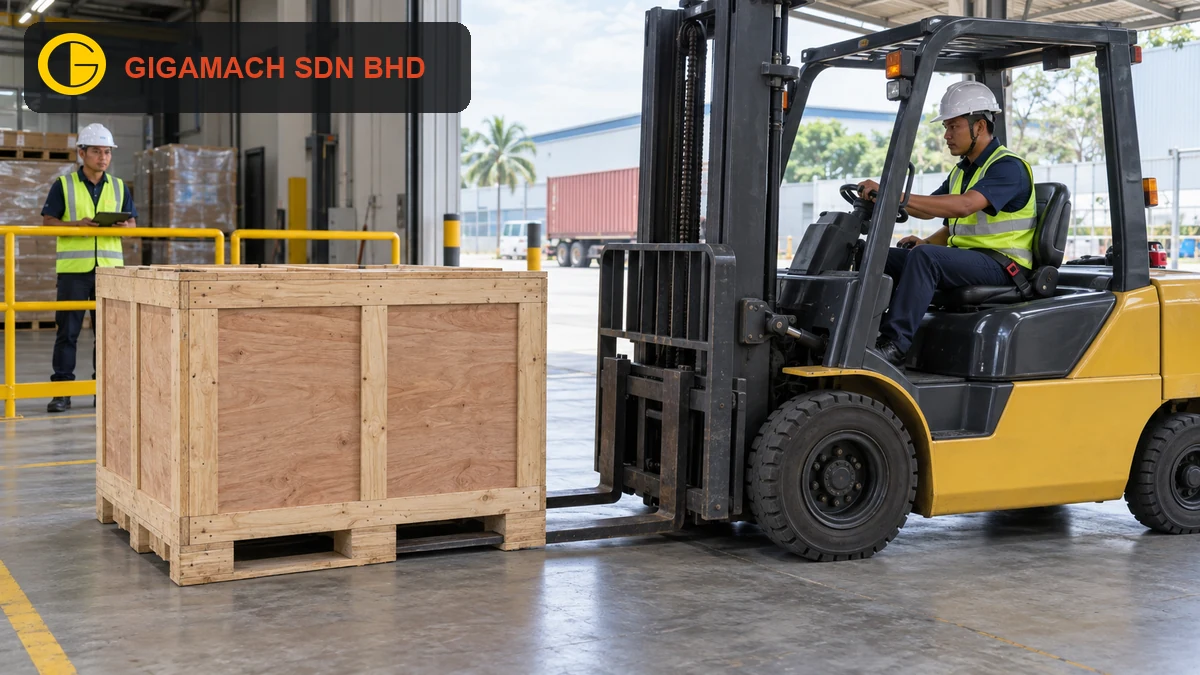
- Check 3: Space the forks as widely as the load safely permits and centre them.
- Check 4: Insert the forks fully beneath sound, intended support points.
- Check 5: Keep everyone clear and make a low trial lift to check stability.
Record the important findings during the site survey and brief the same controls to operators, riggers, signalmen, supervisors, and nearby work teams. Stop and reassess whenever the site condition or equipment configuration differs from the plan.
Common mistakes to avoid
- Using the load weight alone without checking its dimensions and centre-of-gravity position.
- Assuming the capacity shown for one load centre or attachment applies to every configuration.
- Testing an uncertain pickup at height or with pedestrians inside the travel route.
Related planning terms include forklift load centre, forklift load stability, industrial material handling. These should be used naturally to describe the actual work scope, not treated as interchangeable services.
Final verification before work starts
Before lifting, confirm the load, data plate, attachment, fork spacing, support, pickup position, travel route, visibility, ground condition, and pedestrian separation. Test the pickup at minimum practical height and stop if the load or truck behaves unexpectedly.
Center it. Support it. Test it low.
Planning support for industrial work
GIGAMACH SDN BHD provides forklift operations and industrial equipment positioning with a practical safety-first approach. Plan the scope early so the equipment, access, lifting method, transport, and final positioning can be coordinated before work begins.